
Unlocking the statistical value of financial statements: Insights from ECCBSO
Fri, 08/28/2026 - 12:00
Reflections from the ECCBSO presentation at the Irving Fisher Committee (IFC) Annual Committee Meeting
19 August 2026 - Martine Druant and Luis Ángel Maza (1)
At the Annual Committee Meeting of the Irving Fisher Committee on Central Bank Statistics (IFC), the European Committee of Central Balance-Sheet Data Offices (ECCBSO) presented its work on the value of financial statement data for central banks and on the role of national Central Balance Sheet Data Offices (CBSOs) in turning these data into information that is useful for economic analysis and policymaking. The presentation opened with an overview of the ECCBSO itself and of the Central Balance Sheet Data Offices that make it up, before turning to the added value of financial statement data more broadly. This article summarises the main messages of both parts and announces the conference to celebrate the 40th anniversary of the ECCBSO in 2027.
👉 Illustration_Insights from ECCBSO 2026.jpg
Getting to know the ECCBSO
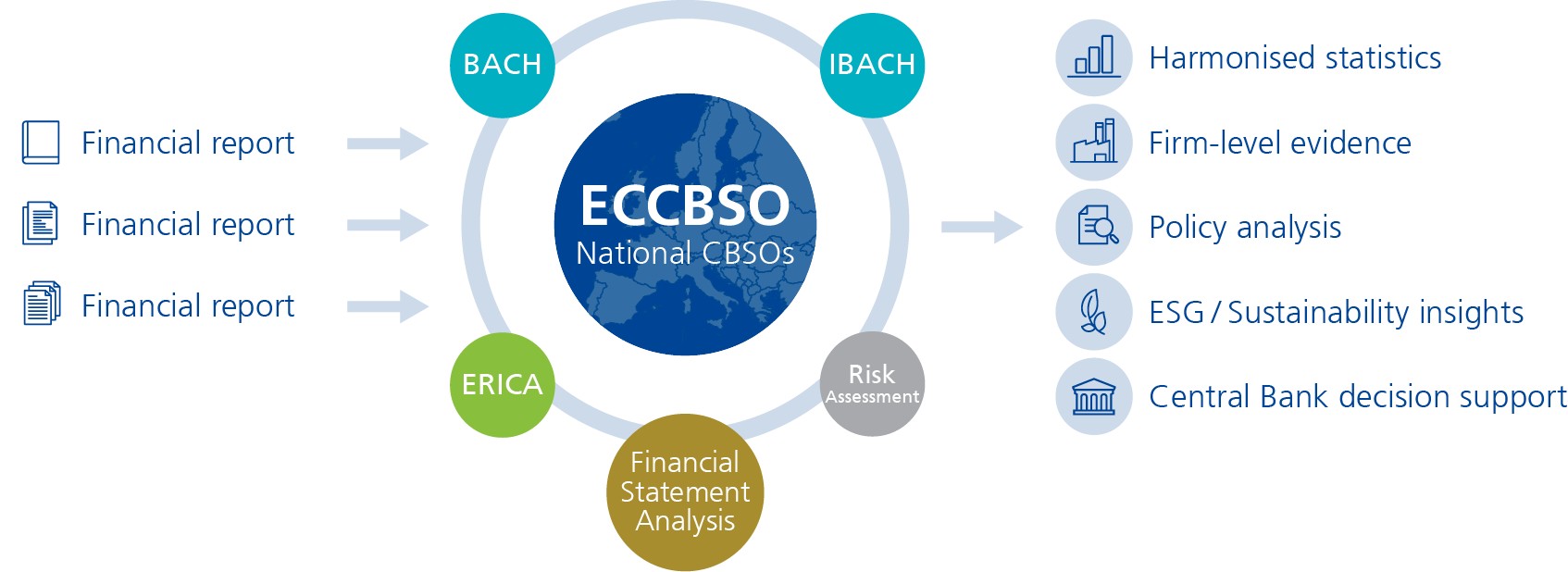
The ECCBSO is a consultative body that brings together 30 national central banks and national statistical institutes across Europe holding databases of firms' financial statements, most of them organised within dedicated national units known as Central Balance Sheet Data Offices. The European Central Bank participates as a member, alongside seven international observers the BIS, the CMFB, Eurostat, the IASB-IFRS, the IMF, the OECD and XBRL. The Committee's work is organised through four working groups: BACH (Bank for the Accounts of Companies Harmonized), ERICA (European Records of IFRS Consolidated Accounts), the Financial Statement Analysis working group, and the Risk Assessment working group.
The ECCBSO's main task is to improve the use and analysis of data on non-financial corporations by harmonising processing methods and tools, sharing and linking data across countries, and carrying out joint analyses on a European basis. This mandate is carried out through the four working groups noted above, each covering a distinct strand of the Committee's work: BACH and iBACH maintain the aggregated and granular accounting databases; ERICA focuses on IFRS consolidated accounts of listed groups; the Financial Statement Analysis working group develops shared analytical methods and indicators; and the Risk Assessment working group works on the use of financial statement data for corporate vulnerability and credit-risk analysis.
For the 2026-2028 term, the Committee has set three key priorities: increasing the visibility and impact of the ECCBSO, putting users first by increasing the usefulness of its data, and building bridges with other institutions and initiatives, both within Europe and beyond.
What national Central Balance Sheet Data Offices offer
Behind the ECCBSO lies a network of national Central Balance Sheet Data Offices that jointly maintain and harmonise three flagship datasets, each addressing a different analytical need.
- ERICA (European Records of IFRS Consolidated Accounts): IFRS consolidated financial statement data for non-financial EU listed groups, covering nine countries from 2005 onwards. It includes around 1,000 groups, with coverage of about 95 % based on turnover, broken down by sector and size class, and combines annual financial and sustainability data.
- BACH (Bank for the Accounts of Companies Harmonized): aggregated financial statement data drawn from individual accounts, covering twelve countries from 2000 onwards. It provides annual financial data — balance sheets, income statements and financial ratios — broken down by sector and size class.
- iBACH: granular financial statement data of individual accounts, covering seven countries from 2000 onwards. Unlike BACH, it offers individual company-level data, again including balance sheets, income statements and financial ratios on an annual basis.
Beyond the datasets themselves, Central Balance Sheet Data Offices pool their technical expertise within the ECCBSO to harmonise data originating from different accounting frameworks across countries. They standardise, structure and enrich data with metadata and identifiers, apply quality assurance procedures, and combine financial statements with other data sources. Their long-standing experience with XBRL and other digital reporting tools — including a dedicated Mapping Tool and alignment with the European Single Electronic Format (ESEF) — has improved machine-readability and interoperability in data collection while reducing reporting burdens. ESG data is already available within ERICA, and work is under way to build a list of environmental indicators aligned with the revised European Sustainability Reporting Standards (ESRS) for integration into the database.
A 40th anniversary conference
To mark its 40th anniversary, the ECCBSO is jointly organising a conference with the BIS Irving Fisher Committee and the National Bank of Belgium on the use of financial statements of non-financial corporations for compiling official statistics. Five topics have been proposed for the call for papers: current practices in countries using financial statements for official statistics compilation; sampling and representativeness of financial statements for that purpose; distributional aspects and the development of experimental statistics; the use of financial statements to meet the new requirements of the 2025 System of National Accounts (SNA 2025); and the use of artificial intelligence to extract and analyse data from financial statements.
As a distinctive feature, the conference will offer a one-off opportunity for researchers to access anonymised firm-level iBACH data through a data-laboratory framework provided by the institutions that make up the ECCBSO. The call for papers is open, with a first deadline of 30 September 2026 for papers requiring access to this firm-level data
(News | ECCBSO).
Ongoing external collaboration
The ECCBSO's infrastructure already underpins a range of external collaboration projects with the BIS, Eurostat, the Committee on Monetary, Financial and Balance of Payments Statistics (CMFB), the European Commission and the European Central Bank/Eurosystem. Building on this track record, the Committee is now actively considering how such cooperation might extend beyond the borders of Europe, opening the door to broader exchanges of experience with statistical and central banking communities elsewhere. It is against this backdrop — a well-established organisation, a rich set of harmonised datasets, and an active network of partnerships — that the Committee's broader case for the value of financial statement data, presented in the next paragraphs, should be understood.
Financial statements: a high-value statistical source
Financial statements are more than accounting documents. By bringing together structured accounting data, explanatory notes and, increasingly, sustainability information, they provide central banks and statistical institutions with a rich source that can be reused for a wide range of statistical and analytical purposes. Three benefits stand out:
- Coverage and comparability. Financial statements provide information on a large number of firms and follow a common accounting language, making it possible to compare companies across sectors, countries and size classes.
- Internal consistency. Accounting data rest on well-defined relationships between variables (balance-sheet identities and accounting links), which helps validate the information and improve its quality.
- Lower reporting burden. Reusing information that firms already produce for accounting purposes reduces duplicate reporting requests and eases the burden on businesses.
From microdata to policy-relevant evidence
The starting point for CBSOs is the information reported by firms — balance sheets, income statements, explanatory notes and, increasingly, sustainability reports. Although rich, these sources are not readily usable for statistical purposes in their raw form. This is why harmonisation is central to the work of CBSOs: data are standardised and validated against business identifiers and metadata, and then mapped to statistical concepts, building a bridge between company accounts and statistical frameworks.
Once harmonised, the data support both aggregate and firm-level analysis, feeding into indicators and benchmarks for the economy as a whole. The final step is policy use: the resulting evidence underpins macroeconomic statistics, financial stability analysis, sustainability assessment and risk monitoring. In short, CBSOs do far more than collect accounting information — they transform firm-level data into harmonised, policy-relevant evidence. The ECCBSO adds value by bringing these data together and embedding them in a common harmonized framework.
A multi-purpose source across central bank work
Financial statement data feed into many areas of central bank statistics. They are essential for business and structural statistics, given the detailed information they provide on firms and sectors, and they support national and financial accounts, particularly for non-financial corporations. They are also key inputs for the analysis of corporate indebtedness and vulnerability, for balance of payments and foreign direct investment statistics where firm-level detail is required, and, increasingly, for sustainability and ESG analysis.
Added value when combined with other sources
The usefulness of financial statements grows further when combined with complementary sources. External geolocation data improve the spatial allocation of firms' activity and support climate-related physical risk assessment; granular loan data strengthen borrower-risk validation when compared with credit registers; and ESG and sustainability reports enable joint analysis of financial and non-financial performance. Administrative and private-sector data can extend the information available while keeping the reporting burden low. Taken together, financial statements act as a backbone for integrating firm-level evidence across these domains.
An innovation agenda for firm-level data
Looking ahead, two areas define the ECCBSO's innovation agenda. First, data science and artificial intelligence can help extract information from explanatory notes and sustainability reports, support large-scale data validation and quality checks, and identify patterns across very large datasets. Second, work on standards, interoperability and cooperation — including XBRL and other digital reporting tools — is making data increasingly machine-readable, while harmonised databases improve comparability across countries.
In this context, the common language provided by International Accounting Standards (IAS/IFRS) offers a natural basis for closer cooperation between the ECCBSO and the IFC community, allowing central banks to share experience, compare methods and pursue joint analytical work. As the ECCBSO's motto for this agenda puts it: central banks are stronger together, and the better use of business data can benefit many institutions when it is built on common standards, shared methodologies and joint research initiatives.
Conclusion
Looking ahead, the combination of a strong institutional framework and an increasingly rich information base places the ECCBSO in a unique position to further enhance the contribution of financial statement data to economic analysis and policymaking. The ECCBSO and its national Central Balance Sheet Data Offices represent a mature and well-governed infrastructure, built on harmonised datasets, technical expertise and an active network of partnerships, that has served central banks for four decades. At the same time, financial statement data have evolved into a valuable multi-purpose statistical resource whose relevance is expected to grow further as digitalisation, sustainability reporting and artificial intelligence transform the production and use of firm-level information. As the Committee approaches its 40th anniversary, its priorities for 2026-2028 include strengthening cooperation across the central banking community, both within and beyond Europe, deepening collaboration with other statistical institutions, and fostering closer engagement with analysts and data users. Particular emphasis will be placed on initiatives that facilitate secure access to granular firm-level data for the research community, while fully respecting confidentiality requirements. By broadening access to these information assets and strengthening cooperation with users, the ECCBSO aims to maximise the public value of financial statement data, ensuring that they can generate new insights for research, economic analysis and evidence-based policymaking.
Contact information
Further information on the ECCBSO, including its statutes, working groups and publications, is available on the Committee's website. Enquiries may also be directed to its current governance team: Martine Druant (ECCBSO Chair 2026-2028, National Bank of Belgium) and Luis Ángel Maza (ECCBSO Vice-Chair 2026-2028, Banco de España), as well as to the Chairs of the four
working groups — Alfredo Maldonado (Banco de España) for ERICA; Susana I. Caleiro (Banco de Portugal) and Pilar Saura (Banco de España) for BACH and iBACH; Nicoletta Berardi (Banque de France) for the Financial Statement Analysis working group; and Florian Resch (Oesterreichische Nationalbank) for the Risk Assessment working group.
(1) Martine Druant is ECCBSO Chair (2026-2028), National Bank of Belgium. Luis Ángel Maza is ECCBSO Vice-Chair (2026-2028), Banco de España. Further information on the ECCBSO's work is available at eccbso.org.