
Publications

Unlocking the statistical value of financial statements: Insights from ECCBSO

Fri, 08/28/2026 - 12:00

Reflections from the ECCBSO presentation at the Irving Fisher Committee (IFC) Annual Committee Meeting
19 August 2026 - Martine Druant and Luis Ángel Maza (1)

At the Annual Committee Meeting of the Irving Fisher Committee on Central Bank Statistics (IFC), the European Committee of Central Balance-Sheet Data Offices (ECCBSO) presented its work on the value of financial statement data for central banks and on the role of national Central Balance Sheet Data Offices (CBSOs) in turning these data into information that is useful for economic analysis and policymaking. The presentation opened with an overview of the ECCBSO itself and of the Central Balance Sheet Data Offices that make it up, before turning to the added value of financial statement data more broadly. This article summarises the main messages of both parts and announces the conference to celebrate the 40th anniversary of the ECCBSO in 2027.


👉 Illustration_Insights from ECCBSO 2026.jpg
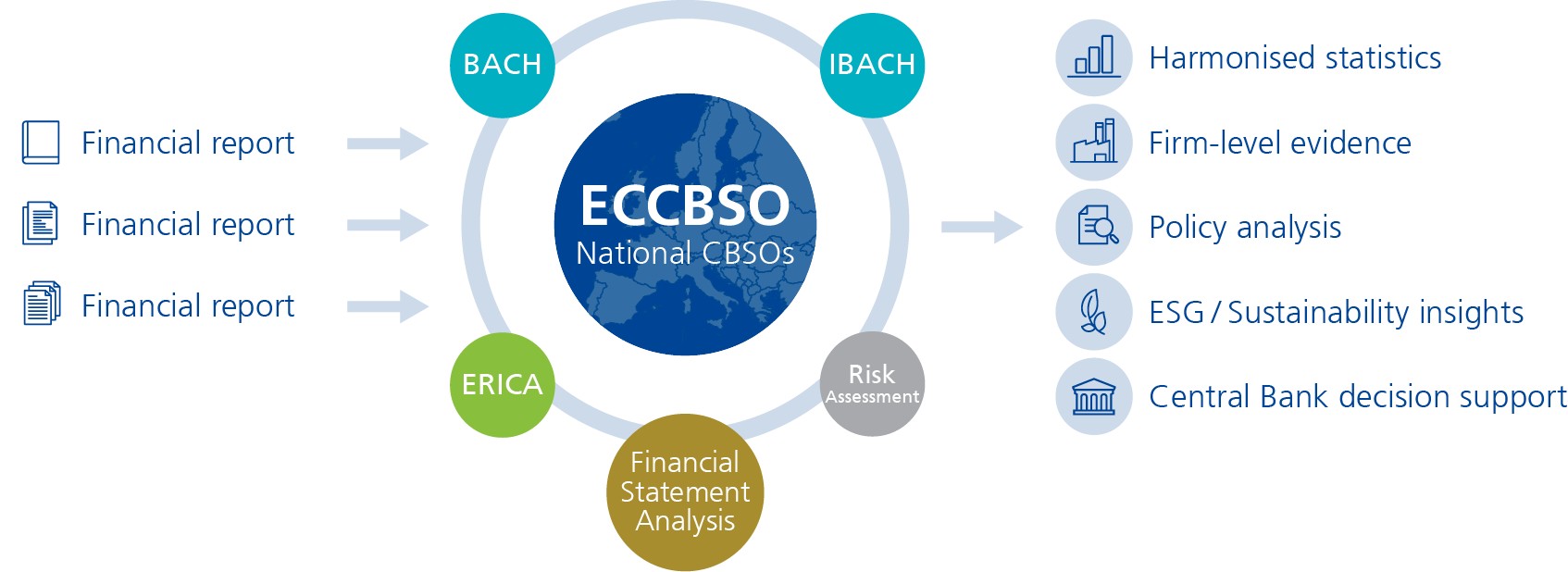
 

Getting to know the ECCBSO


The ECCBSO is a consultative body that brings together 30 national central banks and national statistical institutes across Europe holding databases of firms' financial statements, most of them organised within dedicated national units known as Central Balance Sheet Data Offices. The European Central Bank participates as a member, alongside seven international observers the BIS, the CMFB, Eurostat, the IASB-IFRS, the IMF, the OECD and XBRL. The Committee's work is organised through four working groups: BACH (Bank for the Accounts of Companies Harmonized), ERICA (European Records of IFRS Consolidated Accounts), the Financial Statement Analysis working group, and the Risk Assessment working group.

The ECCBSO's main task is to improve the use and analysis of data on non-financial corporations by harmonising processing methods and tools, sharing and linking data across countries, and carrying out joint analyses on a European basis. This mandate is carried out through the four working groups noted above, each covering a distinct strand of the Committee's work: BACH and iBACH maintain the aggregated and granular accounting databases; ERICA focuses on IFRS consolidated accounts of listed groups; the Financial Statement Analysis working group develops shared analytical methods and indicators; and the Risk Assessment working group works on the use of financial statement data for corporate vulnerability and credit-risk analysis.

For the 2026-2028 term, the Committee has set three key priorities: increasing the visibility and impact of the ECCBSO, putting users first by increasing the usefulness of its data, and building bridges with other institutions and initiatives, both within Europe and beyond.


What national Central Balance Sheet Data Offices offer


Behind the ECCBSO lies a network of national Central Balance Sheet Data Offices that jointly maintain and harmonise three flagship datasets, each addressing a different analytical need.

  • ERICA (European Records of IFRS Consolidated Accounts): IFRS consolidated financial statement data for non-financial EU listed groups, covering nine countries from 2005 onwards. It includes around 1,000 groups, with coverage of about 95 % based on turnover, broken down by sector and size class, and combines annual financial and sustainability data.
  • BACH (Bank for the Accounts of Companies Harmonized): aggregated financial statement data drawn from individual accounts, covering twelve countries from 2000 onwards. It provides annual financial data — balance sheets, income statements and financial ratios — broken down by sector and size class.
  • iBACH: granular financial statement data of individual accounts, covering seven countries from 2000 onwards. Unlike BACH, it offers individual company-level data, again including balance sheets, income statements and financial ratios on an annual basis.

Beyond the datasets themselves, Central Balance Sheet Data Offices pool their technical expertise within the ECCBSO to harmonise data originating from different accounting frameworks across countries. They standardise, structure and enrich data with metadata and identifiers, apply quality assurance procedures, and combine financial statements with other data sources. Their long-standing experience with XBRL and other digital reporting tools — including a dedicated Mapping Tool and alignment with the European Single Electronic Format (ESEF) — has improved machine-readability and interoperability in data collection while reducing reporting burdens. ESG data is already available within ERICA, and work is under way to build a list of environmental indicators aligned with the revised European Sustainability Reporting Standards (ESRS) for integration into the database.


A 40th anniversary conference


To mark its 40th anniversary, the ECCBSO is jointly organising a conference with the BIS Irving Fisher Committee and the National Bank of Belgium on the use of financial statements of non-financial corporations for compiling official statistics. Five topics have been proposed for the call for papers: current practices in countries using financial statements for official statistics compilation; sampling and representativeness of financial statements for that purpose; distributional aspects and the development of experimental statistics; the use of financial statements to meet the new requirements of the 2025 System of National Accounts (SNA 2025); and the use of artificial intelligence to extract and analyse data from financial statements.

As a distinctive feature, the conference will offer a one-off opportunity for researchers to access anonymised firm-level iBACH data through a data-laboratory framework provided by the institutions that make up the ECCBSO. The call for papers is open, with a first deadline of 30 September 2026 for papers requiring access to this firm-level data 
(News | ECCBSO).


Ongoing external collaboration


The ECCBSO's infrastructure already underpins a range of external collaboration projects with the BIS, Eurostat, the Committee on Monetary, Financial and Balance of Payments Statistics (CMFB), the European Commission and the European Central Bank/Eurosystem. Building on this track record, the Committee is now actively considering how such cooperation might extend beyond the borders of Europe, opening the door to broader exchanges of experience with statistical and central banking communities elsewhere. It is against this backdrop — a well-established organisation, a rich set of harmonised datasets, and an active network of partnerships — that the Committee's broader case for the value of financial statement data, presented in the next paragraphs, should be understood.


Financial statements: a high-value statistical source


Financial statements are more than accounting documents. By bringing together structured accounting data, explanatory notes and, increasingly, sustainability information, they provide central banks and statistical institutions with a rich source that can be reused for a wide range of statistical and analytical purposes. Three benefits stand out:

  • Coverage and comparability. Financial statements provide information on a large number of firms and follow a common accounting language, making it possible to compare companies across sectors, countries and size classes.
  • Internal consistency. Accounting data rest on well-defined relationships between variables (balance-sheet identities and accounting links), which helps validate the information and improve its quality.
  • Lower reporting burden. Reusing information that firms already produce for accounting purposes reduces duplicate reporting requests and eases the burden on businesses.


From microdata to policy-relevant evidence


The starting point for CBSOs is the information reported by firms — balance sheets, income statements, explanatory notes and, increasingly, sustainability reports. Although rich, these sources are not readily usable for statistical purposes in their raw form. This is why harmonisation is central to the work of CBSOs: data are standardised and validated against business identifiers and metadata, and then mapped to statistical concepts, building a bridge between company accounts and statistical frameworks.

Once harmonised, the data support both aggregate and firm-level analysis, feeding into indicators and benchmarks for the economy as a whole. The final step is policy use: the resulting evidence underpins macroeconomic statistics, financial stability analysis, sustainability assessment and risk monitoring. In short, CBSOs do far more than collect accounting information — they transform firm-level data into harmonised, policy-relevant evidence. The ECCBSO adds value by bringing these data together and embedding them in a common harmonized framework.


A multi-purpose source across central bank work


Financial statement data feed into many areas of central bank statistics. They are essential for business and structural statistics, given the detailed information they provide on firms and sectors, and they support national and financial accounts, particularly for non-financial corporations. They are also key inputs for the analysis of corporate indebtedness and vulnerability, for balance of payments and foreign direct investment statistics where firm-level detail is required, and, increasingly, for sustainability and ESG analysis.


Added value when combined with other sources


The usefulness of financial statements grows further when combined with complementary sources. External geolocation data improve the spatial allocation of firms' activity and support climate-related physical risk assessment; granular loan data strengthen borrower-risk validation when compared with credit registers; and ESG and sustainability reports enable joint analysis of financial and non-financial performance. Administrative and private-sector data can extend the information available while keeping the reporting burden low. Taken together, financial statements act as a backbone for integrating firm-level evidence across these domains.


An innovation agenda for firm-level data


Looking ahead, two areas define the ECCBSO's innovation agenda. First, data science and artificial intelligence can help extract information from explanatory notes and sustainability reports, support large-scale data validation and quality checks, and identify patterns across very large datasets. Second, work on standards, interoperability and cooperation — including XBRL and other digital reporting tools — is making data increasingly machine-readable, while harmonised databases improve comparability across countries.

In this context, the common language provided by International Accounting Standards (IAS/IFRS) offers a natural basis for closer cooperation between the ECCBSO and the IFC community, allowing central banks to share experience, compare methods and pursue joint analytical work. As the ECCBSO's motto for this agenda puts it: central banks are stronger together, and the better use of business data can benefit many institutions when it is built on common standards, shared methodologies and joint research initiatives.


Conclusion


Looking ahead, the combination of a strong institutional framework and an increasingly rich information base places the ECCBSO in a unique position to further enhance the contribution of financial statement data to economic analysis and policymaking. The ECCBSO and its national Central Balance Sheet Data Offices represent a mature and well-governed infrastructure, built on harmonised datasets, technical expertise and an active network of partnerships, that has served central banks for four decades. At the same time, financial statement data have evolved into a valuable multi-purpose statistical resource whose relevance is expected to grow further as digitalisation, sustainability reporting and artificial intelligence transform the production and use of firm-level information. As the Committee approaches its 40th  anniversary, its priorities for 2026-2028 include strengthening cooperation across the central banking community, both within and beyond Europe, deepening collaboration with other statistical institutions, and fostering closer engagement with analysts and data users. Particular emphasis will be placed on initiatives that facilitate secure access to granular firm-level data for the research community, while fully respecting confidentiality requirements. By broadening access to these information assets and strengthening cooperation with users, the ECCBSO aims to maximise the public value of financial statement data, ensuring that they can generate new insights for research, economic analysis and evidence-based policymaking.


Contact information


Further information on the ECCBSO, including its statutes, working groups and publications, is available on the Committee's website. Enquiries may also be directed to its current governance team: Martine Druant (ECCBSO Chair 2026-2028, National Bank of Belgium) and Luis Ángel Maza (ECCBSO Vice-Chair 2026-2028, Banco de España), as well as to the Chairs of the four 
working groups — Alfredo Maldonado (Banco de España) for ERICA; Susana I. Caleiro (Banco de Portugal) and Pilar Saura (Banco de España) for BACH and iBACH; Nicoletta Berardi (Banque de France) for the Financial Statement Analysis working group; and Florian Resch (Oesterreichische Nationalbank) for the Risk Assessment working group.


(1) Martine Druant is ECCBSO Chair (2026-2028), National Bank of Belgium. Luis Ángel Maza is ECCBSO Vice-Chair (2026-2028), Banco de España. Further information on the ECCBSO's work is available at eccbso.org.


ECCBSO

The Report aims to take stock of the products and services currently developed, and/ or under development in the different Central Balance-Sheet Data Offices members of it. To that aim, it was developed a questionnaire to acknowledge the different work done across Europe. The questionnaire comprises five parts: General Information, Raw data, Products and Services (P&S), Future P&S and Summary Table.

BACH Working Group

Get Insights: Portfolio of selected economic and financial indicators enabling to easily get a picture of the most recent situation of European non-financial corporations also exploring developments on European business environment and specific topics concerning companies.

Outlooks: Analysis papers, dealing with different aspects of the economic and financial situation of European companies, based on information from the BACH database.

  • Outlook #12 (December 2023) - The impact of energy costs on European firms’ profitability
  • Outlook #11 (November 2022) - The Impact of the Covid-19 Pandemic on European Firms
  • Outlook #10 (December 2021) - Past economic performance of climate policy relevant sectors
  • Outlook #9 (January 2021) - European non-financial corporations: a comparison for pre-crisis periods
  • Outlook #8 (October 2020) - Methodological notes on the economic impact of Covid-19 on European firms
  • Outlook #7 (November 2019) - Technological intensity of industries in European non-financial corporations from 2005 to 2017
  • Outlook #6 (October 2018) - High profitability activities: a review on the concepts of profitability
  • Outlook #5 (December 2017) - Assessment of the transposition into national law of the new European Accounting Guideline 2013
  • Outlook #4 (October 2016) - European non‐financial corporations from 2007 to 2014
  • Outlook #3 (October 2015) - Developments in the Deleveraging Process of European Companies Some Effects on the Asset Side
  • Outlook #2 (October 2014) - Financial Structure and Profitability of European Countries
  • Outlook #1 (October 2013) - SMEs in European countries

You may also find a list of studies based on BACH data done by external researchers at the BACH and ERICA website.

ERICA WG

List of documents issued in 2026:

List of documents issued in 2025:

List of documents issued in 2024:

List of documents issued in 2023:

List of documents issued in 2022:

List of documents issued in 2021:

List of documents issued in 2020:

List of documents issued in 2019:

List of documents issued in 2018:

List of documents issued in 2017:

List of documents issued in 2016:

 List of documents issued in 2015:

Previous documents:

Financial Statement Analysis Working Group

List of documents issued in 2025:

List of documents issued in 2024:

List of documents issued in 2023:

List of documents issued in 2022:

List of documents issued in 2021:

List of documents issued in 2019:

List of documents issued in 2018:

List of documents issued in 2017:

Previous documents:

The papers in 1997, 2000 and 2005 were published under the former name "Own Funds Working Group".

The paper in 2013 was published under the name “Study Group”.

Publications associated with the Financial Statement Analysis Working Group:

Mouriaux F., Foulcher-Darwish S.: Corporate equity and financial stability: An approach based on net worth at risk, Banque de France, Financial Stability Review, No. 8, May 2006

Risk Assessment Working Group (WGRA)

The research of the Working Group on Risk Assessment of the ECCBSO is dedicated to credit risk modelling and measurement. Main research contributions are published individually by the single National Central Banks.


WGRA Publications

Credit Risk Assessment Revisited

WGRA (2007), Credit Risk Assessment Revisited

The collection of papers contained in this publication shows well the spirit behind the work of this group. The papers do not only address concrete and timely problems in credit risk assessment from a purely methodological side but also study their practical implications.


European Central Bank (ECB) Publications

https://www.ecb.europa.eu/pub/pdf/scpops/ecb.op284~bbce5257bf.en.pdf?c4411763304b58bdf7a72930a132faa7

Laura Auria, Markus Bingmer, Carlos Mateo Caicedo Graciano, Clémence Charavel, Sergio Gavilå, Alessandra Iannamorelli, Aviram Levy, Alfredo Maldonado, Florian Resch, Anna Maria Rossi, Stephan Sauer (October, 2021) , Overview of central banks' in-house credit assessment systems in the euro area, Occasional Paper Series of ECB, Nr. 284, October 2021

The paper analyses in detail the role of ICASs in the context of the Eurosystem's credit operations, describing the relevant Eurosystem guidelines and requirements in terms of, among other facztors, the estimation of default probabilities, the role of statistical models versus expert analysis, input data, validation analysis and performance monitoring.


Economic Bulletin Issue 6, 2022 (europa.eu)

(September, 2022) , Common minimum standards for incorporating climate change risks into in-house credit assessment systems in the Eurosystem, Economic Bulletin Issue 6, 2022, Issue 6, September 2021

The article describes the common miniumum standards for incorporating climate change risks in ICAS ratings publciations


Österreichische Nationalbank (OeNB) Publications

https://oenb.at/dam/jcr:2e962f5a-21bb-4dcb-b356-28da75dffc48/stat_2015_q4_analyse_leitner.pdf:

Christoph Leitner, Manuel Mayer (2015), Common Credit Assessment System zur BonitÀtsbeurteilung von nichtfinanziellen Unternehmen - das statistische Ratingmodell, "Statistiken": OeNB's quarterly paper series for statistical, Q4/2015

The paper describes the statistical model used in CoCAS for the public audience.


https://oenb.at/dam/jcr:6a55795d-aa3b-4b6a-81f5-29cc843b9389/stat_2016_q3_analyse_leitner.pdf:

Christoph Leitner (2016), Validierung des In-house Credit Assessment Systems der OeNB, "Statistiken": OeNB's quarterly paper series for statistical publciations, Q3/2016

The paper describes the valdiation methodology for ICASs for the public audience.    


https://oenb.at/dam/jcr:da6d987d-9542-4623-ae67-8431f7660854/statistiken_2016_q1_analyse_Wukovits_08.pdf:

Sabine Wukovits (2016), BonitÀtsbeurteilung von nichtfinanziellen Unternehmen - das OeNB-Expertenmodell, "Statistiken": OeNB's quarterly paper series for statistical publciations, Q1/2016

The paper describes the expert modell used in the human analysis of OeNB's ICASs for the public audience.


Banque de France (BdF) Publications

https://www.banque-france.fr/system/files/2023-08/Banque%20de%20France%20%E2%80%93%20Entreprises_guide-fiben-ref-cotation.pdf:

Banque de France, January 2022, La COTATION guide de référence

Description of the credit assessment activity and how the ratings are elaborated


https://econpapers.repec.org/scripts/redir.pf?u=https%3A%2F%2Fpublications.banque-france.fr%2Fsites%2Fdefault%2Ffiles%2Fmedias%2Fdocuments%2Fwp-691.pdf;h=repec:bfr:banfra:691:

Christophe Cahn, Mattia Girotti , Federica SalvadĂš, (August 2018), External Credit Ratings and Bank Lending, Working Papers from Banque de France, WP 691, August 2018

Study on how third-party rating information influences firms' access to bank financing and real outcomes, exploiting a refinement in the rating scale that occurred in 2004.


https://publications.banque-france.fr/sites/default/files/medias/documents/quarterly-selection-of-articles_35_2014-autumn.pdf:

Banque de France (2014), The Banque de France company rating system:a tool to facilitate companies’ access to bank credit, Quarterly selection of articles - Bulletin de la Banque de France, Nr. 35, Autumn 2014

Presentation of the rating of non-financial corporations process by a NCB, highlighting its integration in the mission of the BDF, its main characterics,  its legal framework and its use for credit institutions and companies.


Deutsche Bundesbank (BBk) Publications

https://www.bundesbank.de/en/tasks/monetary-policy/collateral/credit-assessment:

The Bundesbank’s credit assessment system, Website of Deutsche Bundesbank, 19/12/2023

Description of credit assessment for NGAAP companies: Topics covered: Eligibility assessment, Model development process, Ratios, The credit assessment process, Outcome of the credit assessment


https://www.bundesbank.de/en/tasks/monetary-policy/collateral/credit-assessment:

How the Bundesbank assesses the credit standing of groups which report under International Financial Reporting Standards (IFRS), Leaflet on the website of Deutsche Bundesbank,  19/12/2023

Description of credit assessment for IFRS companies: Topics covered: Eligibility assessment, Model development process, Ratios, The credit assessment process, Outcome of the credit assessment


https://www.lswb-magazin.bayern:

Franz Josef Benedikt (06/06/2019), Deutsche Bundesbank bietet umfassenden kostenlosen BonitĂ€ts-Check fĂŒr Unternehmen, Magazine of the regional association of tax consultants and auditors in Bavaria, 06/06/2019

Reasons of credit assessment by ICAS, usage of the credit assessment, process, required information


https://www.bundesbank.de/resource/blob/914034/af4ce3c555a8255a19ce57a0d6d7bc3f/mL/2023-02-technical-paper-data.pdf:

Justus Grundmann, Anna Silberbach, Laura Auria (February 2023), Including Carbon Taxation Risk in Deutsche Bundesbank’s In-house Credit Assessment System (ICAS): An Empirical Analysis, Deutsche Bundesbank technical paper, February 2023

The present exercise aims at analysing the potential financial risks resulting from a carbon intensive production conveyed through an increased tax burden. It is based on the idea of scenario analysis and uses respectively the European Emissions Trading System (EU ETS) and self-reported emission data as a data source for corporations using national generally accepted accounting principles (GAAP) and IFRS.


https://www.suerf.org/suerf-policy-brief/75919/including-carbon-taxation-risk-in-deutsche-bundesbanks-in-house-credit-assessment-system-icas-an-empirical-analysis:

Justus Grundmann, Laura Auria (Oktober 2023), Including Carbon Taxation Risk in Deutsche Bundesbank’s In-house Credit Assessment System (ICAS): An Empirical Analysis, SUERF Policy Brief Nr. 695, October 2023

The present exercise aims at analysing the potential financial risks resulting from a carbon intensive production conveyed through an increased tax burden. It is based on the idea of scenario analysis and uses respectively the European Emissions Trading System (EU ETS) and self-reported emission data as a data source for corporations using national generally accepted accounting principles (GAAP) and IFRS.


https://www.wpk.de:

Die BonitĂ€tsanalyse der Deutschen Bundesbank fĂŒr Wirtschaftsunternehmen, Quarterly magazine (3/2019) of the chamber of auditors

Short description of Bundesbanks credit assessment and its advantages for corporations, auditors and the Bundesbank


Banca d'Italia (BdI) Publications

https://www.bancaditalia.it/pubblicazioni/qef/index.html:

Filippo Giovannelli, Alessandra Iannamorelli, Aviram Levy, Marco Orlandi (17/11/2020),The In-house Credit Assessment System of Banca d’Italia, Banca d'Italia Occasional Papers (no. 586/2020)

Descriptive document on the BI-ICAS aims and functioning, including technical aspects on the system's architecture, process and coverage.


https://www.bancaditalia.it/pubblicazioni/mercati-infrastrutture-e-sistemi-di-pagamento/index.html:

Laura Auria, Markus Bingmer, Carlos Mateo Caicedo Graciano, ClĂ©mence Charavel, Sergio GavilĂĄ, Alessandra Iannamorelli, Aviram Levy, Alfredo Maldonado, Florian Resch, Anna Maria Rossi, Stephan Sauer (November 2021), Overview of central banks’ in-house credit assessment systems in the euro area, Markets, Infrastructures, Payment Systems; Institutional Issues (no. 13/2021)

Comparative description of all the ICASs developed within Eurosystem


https://www.bancariaeditrice.it/la-gestione-dei-rischi-finanziari-e-climatici:

Il sistema interno della Banca d’Italia per la valutazione del merito di credito delle imprese, La gestione dei rischi finanziari e climatici. L'esperienza in una banca centrale. Bancaria Editrice, April 2022. 

Single chapter (within a broader pubblication) describing the BI-ICAS aims and functioning, including technical aspects on the system's architecture, process and coverage.


https://www.bancaditalia.it/pubblicazioni/mercati-infrastrutture-e-sistemi-di-pagamento/index.html:

Stefano Di Virgilio, Ivan Faiella, Alessandro Mistretta, Simone Narizzano (September 2023), Assessing credit risk sensitivity to climate and energy shocks, Market, Infrastructures, Payment System

The paper assess the senstivity of italian firms (evaluated by the ICAS model) to the introduction of a carbon tax. The carbon tax can take different values according to the NGFS scenario and its impact is projected to the balance sheet via the elasticity of the demand for energy consumption.


Banco de Portugal (BdP) Publications

https://www.bportugal.pt/en/paper/firm-default-probabilities-revisited:

António Antunes, Homero Gonçalves, Pedro Prego (April 2016), Firm default probabilities revisited

This article describes a tool to assess the creditworthiness of the Portuguese non-financial firms.


Banco de Espana (BdE) Publications

https://www.bde.es/f/webbde/GAP/Secciones/Publicaciones/InformesBoletinesRevistas/RevistaEstabilidadFinanciera/20/mayo/en/Banco_Espana_in_house_credit.pdf:
Sergio Gavilå, Alfredo Maldonado, Antonio Marcelo, The Banco de España in-house credit assessment system, Banco de España Financial Stability Review, Issue38

The paper describes the role of ICASs in general and the Banco de España ICAS in particular as a source of credit assessment, including aspects on the non-financial companies assessed, information sources, credit assessment system (statistical and expert model) and expansion plans.


https://www.bde.es/f/webbde/SES/Secciones/Publicaciones/PublicacionesSeriadas/DocumentosOcasionales/20/Files/do2020e.pdf:

Roberto Blanco, Sergio Mayordomo, Álvaro Menéndez, Maristela Mulino (2020), Spanish Non-financial corporations' liquidity needs and solvency after the covid-19 shock, Banco de España Occasional Paper, No. 2020

The paper analyses the impact of the Covid-19 pandemic on Spanish non-financial corporations. Banco de España ICAS' ratings are used as input to assess the impact on the financial vulnerability of the companies


https://www.bde.es/f/webbde/SES/Secciones/Publicaciones/InformesBoletinesRevistas/BoletinEconomico/23/T2/Files/be2302-art06e.pdf:

Sergio GavilĂĄ, Lola Morales (06/06/2023), The role of loans and the ICAS BE in the Eurosystem’s collateral framework in 2023, Banco de España Economic Bulletin, 2023/Q2

The paper analyses the recent evolution of the share of non-marketable assets pledged as collateral by the Spanish counterparties in the monetary policy credit operations focusing on the current and future role played by the Banco de España’s corporate credit assessment system (ICAS BE) 


National Bank of Poland (NBP) Publications

Distribution of credit-risk concentration in particular sectors of the economy, and economic capital before and during the COVID-19 pandemic | Economic Change and Restructuring (springer.com):

Distribution of credit-risk concentration in particular sectors of the economy, and economic capital before and during the COVID-19 pandemic, Econ Change Restruct 56, 129–158 (2023)

The aim of the work underpinning this paper has been to track the evolution of tail risk in banks’ NPL portfolios present under normal and worst conditions (before and during the pandemic of COVID-19), and to estimate the impact of sector concentration risk on amounts of economic capital. 


https://papers.ssrn.com/sol3/papers.cfm?abstract_id=4545090:

Natalia Nehrebecka, Kai Xing, (2023), The Relationship between ESG Performance and Corporate Financial Performance, SSRN (2023)

This paper presents the economic theories related to ESG (Environment, Society, Governance), CSR (Corporate Social Responsibility) and CFP (Corporate Financial Performance). The main goal is to analyze the relationship between ESG performance and corporate financial performance using a sample of 1719 non-financial companies listed on S&P 500, Nikkei 500, S&P ASX 300, CSI 300, FTSE 350 and S&P Europe 350 index and considering a time span of twelve years (from 2010 to 2021).


Bank of Greece (BoG) Publications

Int  J Fin Econ - 2024 - Credit risk modelling within the euro area in the COVIDñ€19 period  Evidence from an ICAS Framework.pdf: